Our trees are struggling
This current series of heatwaves may suit some – more visits to the beach, swimming, staycations rather than going abroad to find better weather. However, there are also the problems it is creating. Plants struggling to survive; people suffering with heat stroke and 1300 deaths reported by the BBC; and wild fires. Temperatures recently peaked at 37.7C in Norfolk, according to provisional figures reported by the BBC. It was one of several areas to surpass the UK’s previous June high of 35.6C, set in 1957 and also in 1976.
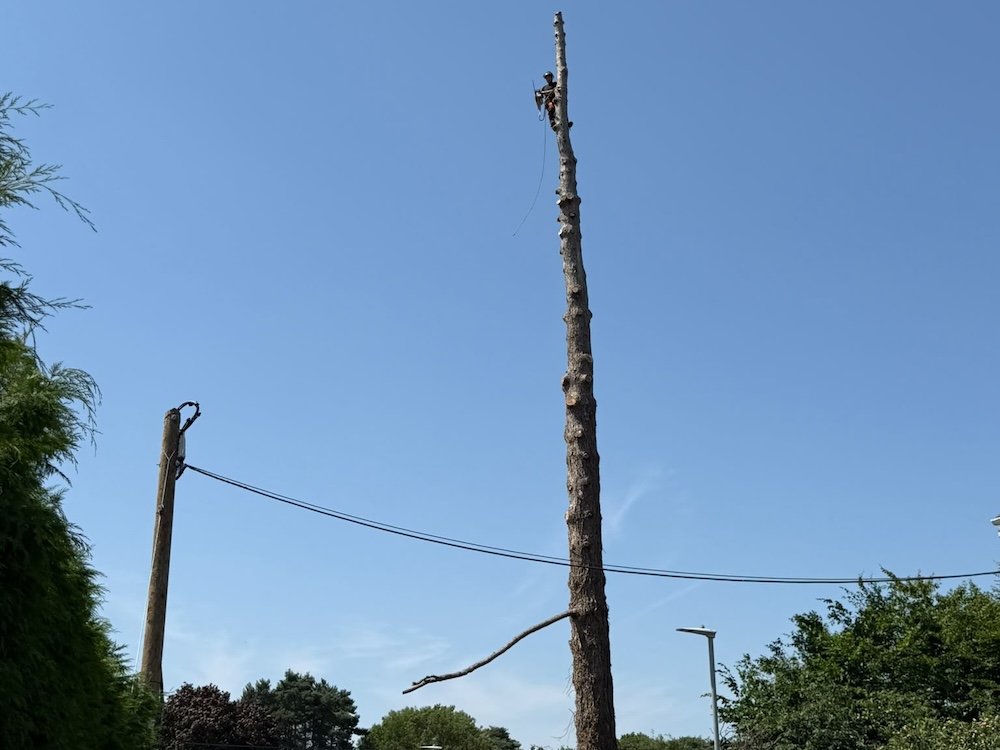
However, maybe a less widely known problem is that trees are suffering. When we did our first tree walk in December 2024 one of the trees we visited was a pine tree in Corams Lane. One of the first trees nominated and included in people’s favourite trees on our tree page. Sadly that tree has now died and was recently felled as can be seen in this photograph. We are not certain why it died, but it is likely to be down to stress, which may include lack of water. An oak tree in Fox’s Field is collapsing and in many places trees are dropping branches.
In 2022 the heatwave killed 400 trees in London’s Kew Gardens. This is now being repeated across the country. Mature trees are losing limbs and branches during these intense periods of hot, dry weather. Canopies are thinning, and some are dying altogether.
To many of us, these changes appear sudden, but in fact they are the visible signs of a process that has been going on for some time. It is a result of the combined effects of high temperatures and lack of rain. As a result trees find it difficult to keep cool. Water is drawn up the tree from the roots and then evaporated through the leaves. That process keeps the tree cool. This works well when there is plenty of water available. However, when there is a long dry period, air pockets create blockages in the trees vascular system (xylem). The result is that the tree starts to die back.
In the UK trees have developed under relatively wet winters and moderate summers. They are now trying to cope with conditions not experienced during their evolution. There are things that can be done to help. Occasional deep watering is better than more frequent light watering, because it encourages the roots to go deeper. In mature woodland, planting more diverse species that are better able to survive draught conditions will help.
This article is based on information in an article published by The Conversation and the BBC. It seems likely that we are going to experience more summers like this. “Human-induced climate change has made events like this more likely and more intense,” said Prof Stephen Belcher, chief scientist at the UK Met Office.